The Israeli Flag: From Zionist Banner to National Emblem

Updated: Jun 11
The Israeli flag is more than a national emblem; it is a bridge between ancient memory and modern statehood. While it feels timeless today, its design was actually the result of intense debate, competing visions, and a creative spark that turned a sacred object into a political symbol.
Here is how a movement's banner became the official flag of the State of Israel in 1948.
Herzl’s Vision: Seven Golden Stars
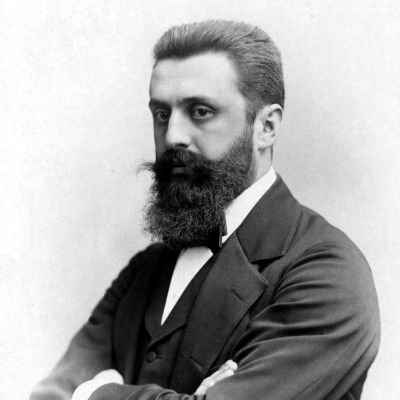
The journey began in 1896. Theodor Herzl, the father of modern Zionism, knew that a movement preparing to launch a nation needed a powerful visual anchor. In his foundational book The Jewish State, he laid out a specific, highly symbolic proposal:
“We have no flag, and we need one. If we desire to lead many men, we must raise a symbol above their heads. I would suggest a white flag, with seven golden stars. The white field symbolizes our pure new life; the stars are the seven golden hours of our working day. For we shall march into the Promised Land carrying the badge of honor.”(Herzl, Theodore, chap. 5)
Herzl’s design focused on the future—specifically, the social ideal of a modern, enlightened society with a seven-hour workday. However, as the First Zionist Congress in Basel approached in 1897, the visual language of the movement was still up for grabs.

The Basel Debate: Finding the Right Colors
As the congress neared, Herzl's inner circle wrestled with how to decorate the hall. Isidor Schalit, Herzl’s assistant, initially envisioned a flag bursting with secular, revolutionary colors. He noted:
I was bothered by the question of the flag. Herzl's preference was for the flag he proposed in The Jewish State: seven gold stars on a white background – a symbol of the labor and peace regime where a seven-hour workday would prevail... I suggested the flag of the Zionist-Academic Association Kadima: blue-red-yellow, where blue symbolized hope, red represented our spilled blood, and yellow stood for the coveted freedom we would attain... I did not receive explicit instructions and decided, based on my own judgment, to raise a blue and white flag. Indeed, (...) I remembered that I arrived at this choice based on the conversation between David Wolffsohn and Herzl: relying on the colors of the Talith seemed very appropriate to Herzl.
Schalit ultimately chose blue and white because he recalled a crucial conversation between Herzl and David Wolffsohn, a prominent Zionist leader who would later succeed Herzl.
Wolffsohn had realized that the movement didn't need to invent a new palette; it already had one.
Wolffsohn’s Spark: Unrolling the Tallit
Wolffsohn’s own account describes the exact moment of inspiration that bypassed Schalit's multi-colored ideas and Herzl's golden stars:
“At the behest of our leader Herzl, I came to Basle to make preparations for the Zionist Congress. Among many other problems that occupied me then was one which contained something of the essence of the Jewish problem. What flag would we hang in the Congress Hall? Then an idea struck me. We have a flag — and it is blue and white. The talith (prayer shawl) with which we wrap ourselves when we pray: that is our symbol. Let us take this Talith from its bag and unroll it before the eyes of Israel and the eyes of all nations. So I ordered a blue and white flag with the Shield of David painted upon it. That is how the national flag, that flew over Congress Hall, came into being.”
The creation of the flag is mainly attributed to Wolffsohn.
By superimposing the ancient Star of David onto the familiar blue-and-white stripes of the prayer shawl, Wolffsohn created an instant emotional connection for Jews worldwide.
From Zionist Congress to the Declaration of Independence

For the next fifty years, Wolffsohn’s design served as the universal banner for the Zionist movement. In May 1948, it hung prominently behind David Ben-Gurion as he read the Declaration of Independence, sealing the birth of the State of Israel.
But a new dilemma immediately arose: Should a political movement’s banner automatically become the flag of a sovereign state?
Some argued that a new country required a fresh start, or feared that using the Zionist flag might cause confusion for Diaspora Jews who were citizens of other nations. For six months, the provisional government debated various alternatives. Ultimately, the deep historical roots of the Basel banner won out.
On October 28, 1948, the Provisional Council of State published the definitive blueprint in the Official Gazette:
“The Provisional Council of State hereby proclaims that the flag of the State of Israel shall be as illustrated and described below: The flag is 220 cm. long and 160 cm. wide. The background is white and on it are two stripes of dark sky-blue, 25 cm. broad, over the whole length of the flag, at a distance of 15 cm. from the top and from the bottom of the flag. In the middle of the white background, between the two blue stripes and at an equal distance from each stripe is a Star of David, composed of six dark sky-blue stripes, 5.5 cm. broad, which form two equilateral triangles, the bases of which are parallel to the two horizontal stripes.”25 Tishrei 5709 (28 October 1948) – Provisional Council of State, by Joseph Sprinzak, Speaker
The Anatomy of the Symbolism
The final, official design beautifully codified centuries of tradition into standard state dimensions:
The Blue Stripes: Modeled directly after the tallit (prayer shawl).
The Colors (White and Blue): Deeply rooted in Jewish history, these colors mirror the garments worn by the High Priest during Yom Kippur in the ancient Temple.
The Star of David (Magen David): A central symbol identified with Jewish art, culture, and community since antiquity.
By weaving these elements together, the Israeli flag successfully achieved what Herzl originally set out to do: it raised a symbol above the heads of many, transforming a centuries-old spiritual identity into the visual anchor of a modern nation.
Sources :
Britannica. “Flag of Israel.” Britannica. https://www.britannica.com/topic/flag-of-Israel
Knesset. “Herzl Letter / The Jewish State excerpt.” https://knesset.gov.il/vip/herzl/eng/Herz_Letterfr1_eng.html
Israeli Ministry of Foreign Affairs. “The Flag and the Emblem.” https://embassies.gov.il/MFA/AboutIsrael/Israelat50/Pages/The%20Flag%20and%20the%20Emblem.aspx
Jewish Virtual Library. “Israel National Symbols: The Israeli Flag.” https://www.jewishvirtuallibrary.org/jsource/History/isflag.html
Jewish Virtual Library. “The Israeli Flag.” https://www.jewishvirtuallibrary.org/the-israeli-flag
World Jewish Congress. “28 October 1948 | Provisional Council of State unveils Israeli flag.” https://www.worldjewishcongress.org/en/videos/jewish-world/28-october-1948--provisional-council-of-state-unveils-israeli-flag
World Jewish Congress. “This Week in Jewish History | Israeli Provisional Council of State unveils Israeli flag.” https://www.worldjewishcongress.org/en/news/this-week-in-jewish-history--israeli-provisional-council-of-state-unveils-israeli-fl


Comments